Kristen Schuyler
Not Without HopeKristen Schuyler is Nick Schuyler’s older sister and one of the book’s most important family witnesses. Three years older than Nick, she is portrayed as an accomplished athlete, an exceptionally driven student, and a woman whose practical decisiveness coexists with deep attachment to her brother. During the search for Nick, Marquis Cooper, Corey Smith, and Will Bleakley, Kristen becomes an active intermediary between the families, the Coast Guard, and the uncertain flow of public information. Her confidence that Nick will survive is gradually forced into confrontation with the possibility of his death, and her eventual reunion with him gives the rescue a distinctly familial meaning rather than allowing it to remain only a maritime operation.
Identity and Background
Kristen was twenty-seven when the accident occurred, three years older than Nick. She was tall, standing five feet nine inches, with light brown hair and a strong, athletic build. In high school she played shortstop and outfield in fast-pitch softball, including a tournament in Lyon, France. She received scholarship offers from schools such as Ohio State but chose to attend the University of South Florida, where she had wanted to study in Florida rather than follow the most prestigious available offer.
Her academic history sharply distinguishes her from Nick. School came naturally to Kristen, and she actively enjoyed studying. While still in high school, she took courses at a community college; she completed college at twenty, later returned to Ohio to finish her undergraduate degree at Kent State University, and earned an MBA from Cleveland State at twenty-three. She maintained employment even when she did not strictly need the income and later worked as a representative for a company distributing dental supplies. The contrast was a familiar family joke: Kristen said she had the brains while Nick had the looks, while Nick compared his unfinished plans at twenty-three with his sister’s completed master’s degree at the same age.
Relationship with Nick Schuyler
Kristen and Nick had always been close, although their personalities and educational paths differed dramatically. As children, Nick idolized her. She was athletic, popular, and socially confident, and she could physically overpower him in their playful fights. Her example helped establish the standard against which he measured himself, even as he pursued sports with a different kind of intensity.
Kristen also understood the stubborn force of Nick’s ambition. When he left Kent State University, moved to Florida, and worked with his father painting and hanging drywall, he had not played football for five years. Yet in 2005 he began preparing to try out for the University of South Florida team by painting forty-yard-dash lines on the road, running stadium steps, jumping fences at night, and training with relentless discipline. Kristen had once worked with him as a personal trainer, where he demanded exact sprint times and withheld her water bottle until she met the designated mark. To her, the attempt to make the team was the greatest challenge of his life, and his history suggested that once he decided on something, he usually accomplished it.
Their closeness also appeared in ordinary domestic moments. On the Friday night before the fishing trip, Kristen stayed at Nick’s house because she planned to run a 5K race the following morning. She slept in Will Bleakley’s room while Will took the sofa in the living room. When Kristen rose at two in the morning, Will was still awake with the television on; she told him he should go to bed, but he answered that he could not because he was too excited. The scene placed Kristen near the men just before their departure and gave her a final, mundane point of contact with the trip that would transform her family.
From Reassurance to Alarm
Kristen’s first response to Nick’s absence was not immediate catastrophe. She had texted him Saturday night about Major League Baseball players at a black-tie breast-cancer fund-raiser, and his failure to answer did not initially alarm her because he sometimes ignored messages unless she asked a direct question. The next morning, however, her call went straight to voice mail. When Paula Oliveira told her that Nick was missing, Kristen first assumed that he and Paula might have argued or broken up. Paula’s correction—Nick was missing—converted an ordinary relationship worry into a crisis.
The change was physical and immediate. Kristen felt dread in her stomach as she connected Nick’s silence with the cold, windy weather and his failure to return from the fishing trip. She paced around her bedroom, went outside without speaking to her mother, and waited for a call saying that everything was fine. No such call came. Ten minutes later she returned to sit beside Marcia Schuyler, whose blank expression revealed that the danger had become impossible to conceal. When Marcia asked what had happened to Nick, Kristen told her that he had not returned. Marcia became sick, and mother and daughter hurriedly packed clothes, showered, and left for Tampa while Marcia sobbed in the shower.
The broader emergency was also being distorted by incomplete information. The Coast Guard initially received notice that a twenty-one-foot Everglades fishing boat was overdue and was mistakenly told that only two other passengers were aboard. Notification was delayed while officials assessed the vessel’s destination, the rough weather, the lack of maritime experience, and the possibility that the men had been in the Gulf of Mexico for hours. The case was upgraded from alert to distress at 2:37 a.m.; later, a Coast Guard dispatch suggested checking credit cards and searching closer to shore because inexperienced boaters might not have gone as far offshore as expected. Kristen’s family therefore lived inside a crisis whose facts were changing as quickly as the sea conditions.
Witness to the Search and Rescue
As the search intensified, Kristen helped sustain the family’s connection to the operation. Paula Oliveira went to St. Paul’s Catholic Church, where she prayed for Nick, Will, Marquis, and Corey, and the Coast Guard later warned that the media would be alerted. Kristen and Marcia traveled from Fort Myers toward St. Petersburg across the Sunshine Skyway Bridge. Rain and whitecaps had replaced the bridge’s usual expansive view, and the sight of the waves made Kristen extremely frightened while Marcia repeatedly said she could not lose her son.
Kristen nevertheless tried to preserve hope. She sent mass text messages asking people to pray and attempted to sound upbeat, even while some recipients responded with judgmental questions about why the men had gone out or with ignorant demands to know where they were. Her insistence that she would not be asking for prayers if she knew their location reveals the gap between public speculation and the family’s actual uncertainty. The Coast Guard was deploying aircraft and vessels into seas running eight to ten feet, sometimes twelve feet, with thirty-mile-per-hour winds and visibility of only half a mile; Kristen’s reassurances had to coexist with conditions that made survival increasingly doubtful.
Five minutes after leaving Nick’s house, Kristen received a message saying that a man had been found and that he might be her brother. Although the sender was unreliable and not even in Tampa, the possibility overwhelmed her. Her knees went weak; she ran back crying, her legs giving out beneath her. The message’s uncertainty made it more painful rather than less: hope arrived not as confirmed news but as a fragment that could collapse at any moment.
Reunion and Aftermath
On Monday morning, while Nick remained missing, Kristen put on one of his sweatshirts so that she could have part of him wrapped around her. Marcia did the same and wore Nick’s socks while sitting in his favorite recliner, crying, praying, changing television channels, and clenching her fists. The clothing turned his absence into a physical presence, an improvised family ritual against the possibility that he would never return.
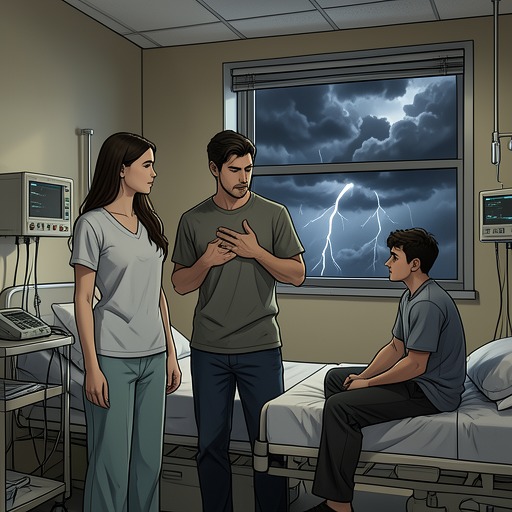
When Kristen finally saw Nick, he was bleeding, pale, thin, dehydrated, and struggling to keep his eyes open. His skin was salty and his toes were icy. He asked who was in the room, and Kristen identified herself before kissing him. Investigators asked about the other men, and Nick indicated that they were all gone. A television report then announced, incorrectly and without confirmation, that Marquis Cooper had also been found. Kristen briefly wondered whether Nick might be hallucinating, but Nick rejected the report. The exchange marked the collapse of the family’s last hope that the rescue had recovered more than one survivor.
Kristen’s presence also appears in the visual record of the story: a photograph shows her with Nick and Marcia at a Cleveland Cavaliers game, preserving the family bond beyond the emergency itself. A month after the accident, the Cleveland Cavaliers gave Nick tickets when they played in Orlando, and he met LeBron James, who asked sincerely about Marcia. For Kristen, such moments belonged to a changed family reality: public recognition could not undo the loss, but it could acknowledge the people who had endured it.
Narrative Significance
Kristen’s role is not that of a rescuer on the water, yet the book uses her to show how a maritime disaster propagates through families and information networks. She receives the first destabilizing disclosure from Paula, watches official accounts change from three missing men to four, encounters unconfirmed television reports, and tries to keep prayer and hope alive while the search becomes increasingly dangerous. Her experience demonstrates that disaster is not confined to the capsized boat; it also occupies living rooms, highways, hospital corridors, telephones, and the long interval before facts become reliable.
Her character further clarifies Nick’s identity. She remembers him as the child who pursued athletic excellence, the brother who trained with obsessive precision, and the walk-on who treated making the University of South Florida football team as a defining challenge. The book’s account of the four men emphasizes that Marquis Cooper and Corey Smith played in the National Football League and that Will Bleakley had been a college tight end, but Kristen’s perspective keeps Nick from becoming merely the strongest survivor in a public rescue story. He remains her younger brother, whose sweatshirt and socks can temporarily stand in for his body and whose return is first experienced as a family miracle before it becomes a media event.
Kristen’s movement from certainty to terror and then to direct witness also resists simplistic accounts of courage. She begins by imagining that the men are safe and merely inconvenienced, later confronts the possibility that the boat has overturned, and finally sees the bodily consequences of forty-three hours at sea on the brother she had always regarded as extraordinarily determined. Her response does not resolve the central question of why Nick survived when Marquis, Corey, and Will did not. Instead, it places that question inside the continuing obligations of kinship: waiting, relaying information, protecting hope, and recognizing that survival leaves a family changed even when one beloved person comes home.